
This is one of the most common questions asked by mining operators and maintenance teams. When a hose fails earlier than planned, the first reaction is often to blame the hose quality.
However, premature wear is not always caused by the rubber compound alone. The actual service life of a mining hose is influenced by several connected operating conditions, including:
- Particle size
- Slurry concentration
- Flow velocity
- Working pressure
- Hose bending
- Hose selection
Understanding these factors can help you reduce unplannedWhy did my slurry hose wear out much faster than expected?”
shutdowns, lower replacement costs, and select a hose that is better suited to the application.
## Why Does Premature Hose Wear Happen?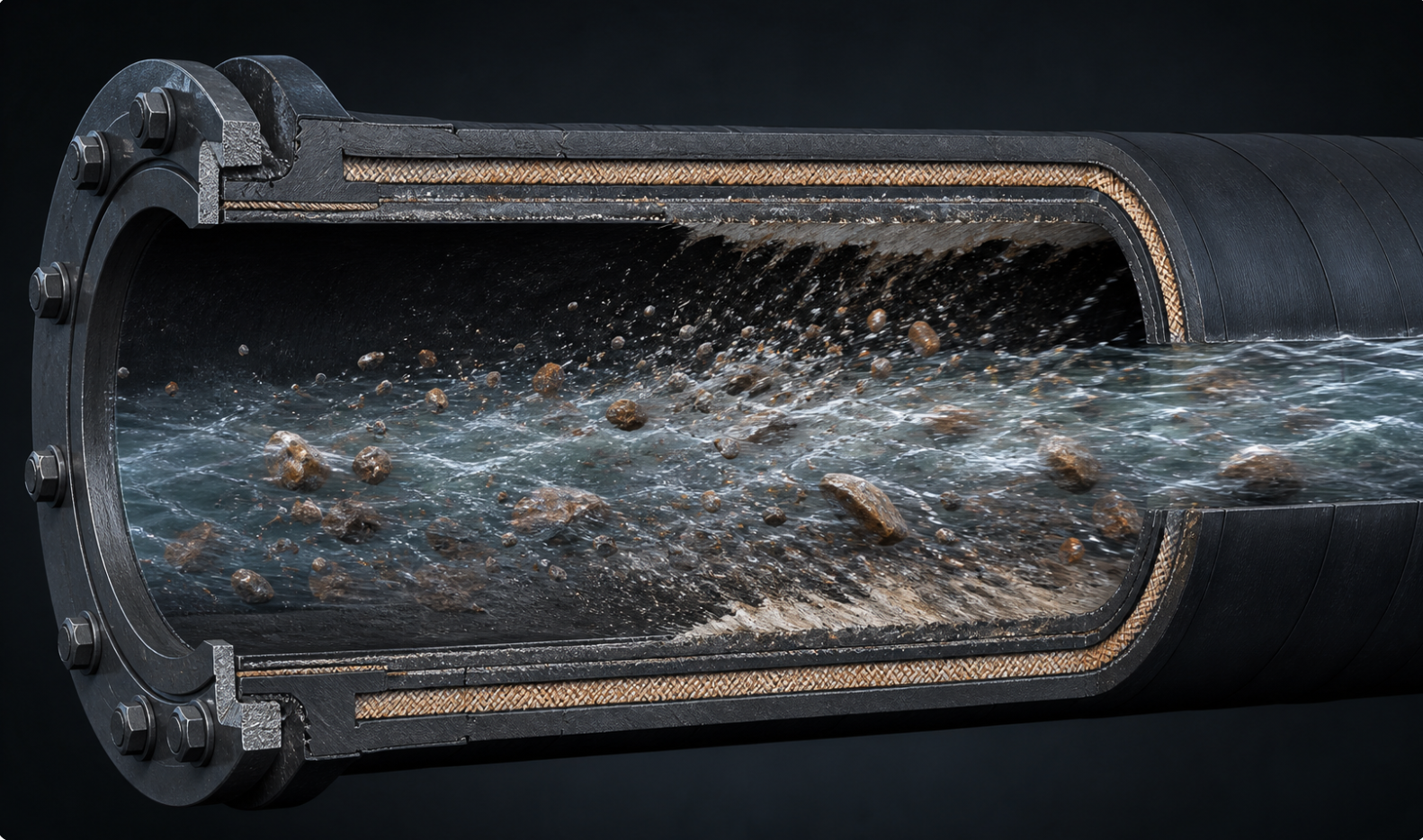
Mining slurry is not an ordinary liquid. It is a mixture of water and solid particles such as ore, sand, tailings, coal, or mineral concentrates.
As the slurry travels through a hose, the solid particles continuously strike, scrape, and cut the inner tube. Over time, this causes material loss. The rate of wear depends not only on the hose construction but also on the characteristics of the slurry and the operating system.
In many cases, several factors act together. For example, a hose carrying large, sharp particles at high velocity through a tight bend will wear much faster than the same hose transporting fine particles through a straight pipeline.
## Technical Factors That Affect Mining Hose Life
### 1. Particle Size and Shape
Larger particles generally carry more impact energy. When they strike the hose wall, especially around bends, they can remove the inner lining more quickly.
Particle shape also matters. Rounded particles tend to create less cutting damage than sharp or angular particles. Crushed ore, for example, may be significantly more aggressive than naturally rounded sand, even when the average particle size is similar.
Before selecting a hose, it is important to understand:
- Maximum particle size
- Average particle size
- Particle hardness
- Whether the particles are rounded or angular
Looking only at the slurry’s chemical composition is not enough.
### 2. Slurry Concentration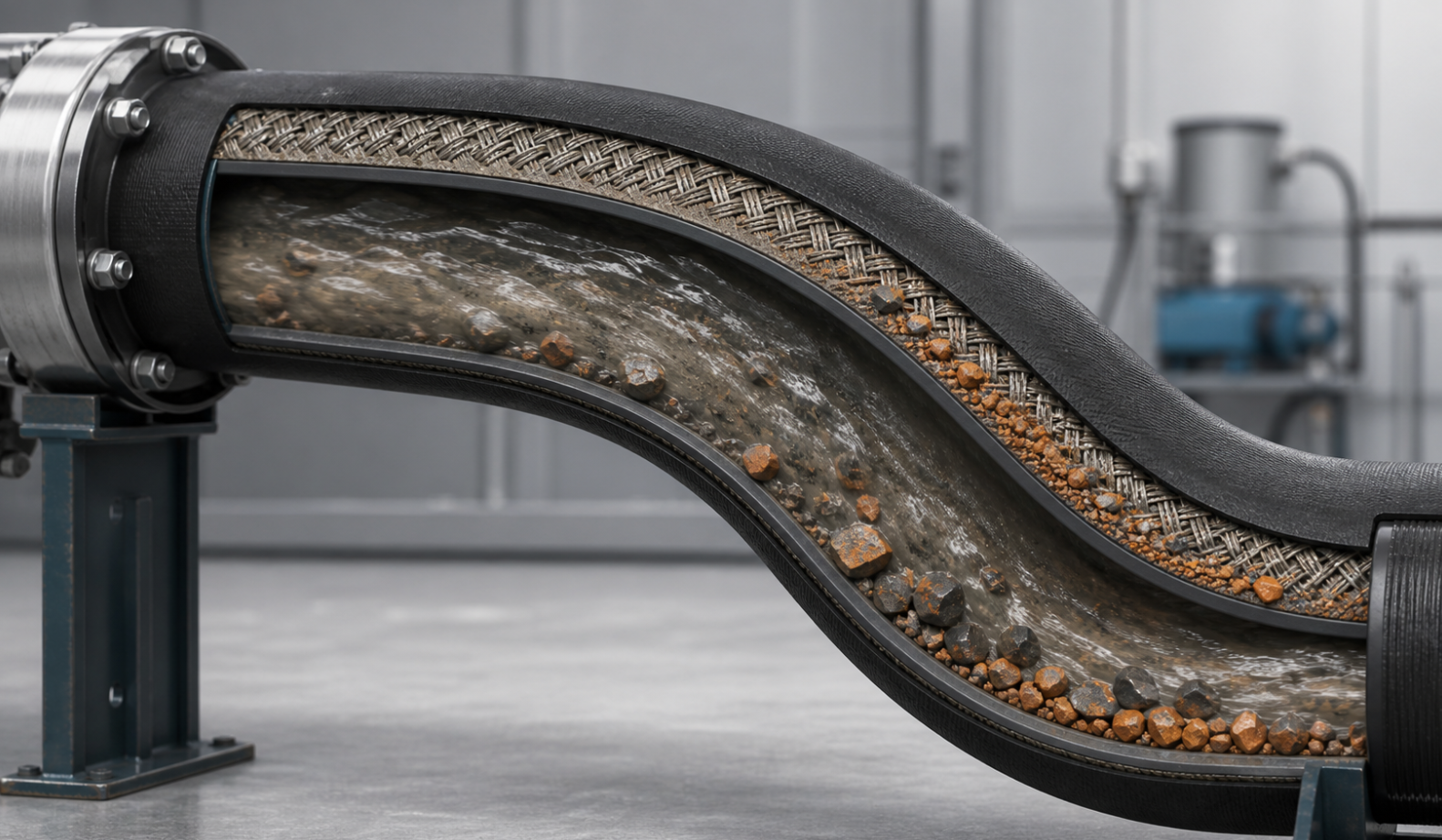
A higher concentration means that more solid material passes through the hose during a given period. This increases contact between the particles and the inner tube.
However, slurry behavior is not always linear. Depending on the particle distribution and carrier fluid, a very dilute slurry may allow particles to move more freely and strike the hose wall at higher relative speeds. A concentrated slurry may also generate greater friction and require higher pumping pressure.
For accurate hose selection, slurry concentration should be expressed clearly as solids by weight or solids by volume.
### 3. Flow Velocity
Flow velocity is one of the most important—and often underestimated—causes of rapid wear.
As velocity increases, particles hit the hose wall with greater energy. Even a small increase in operating speed can produce a substantial increase in abrasion, particularly at bends, reducers, and other areas where the flow direction changes.
A larger hose diameter may reduce velocity if the flow rate remains unchanged. However, the velocity must still be high enough to prevent solid particles from settling and blocking the line.
The correct solution is therefore not simply “the lowest possible velocity.” The system needs a controlled operating range that balances wear resistance, transport efficiency, and settling risk.
### 4. Working Pressure and Pressure Surges
A hose must be selected according to its actual working pressure—not just the pump’s nominal pressure.
Temporary pressure surges can occur during:
- Pump start-up or shutdown
- Valve operation
- Pipeline blockage
- Sudden changes in slurry concentration
- Water hammer
- Pump pulsation
If the pressure repeatedly approaches or exceeds the hose rating, the reinforcement layers may fatigue. This can lead to swelling, deformation, coupling movement, or sudden failure, even if the inner tube still appears usable.
The hose’s working-pressure rating, burst-pressure safety factor, and coupling system must all be considered together.
### 5. Bending and Installation Layout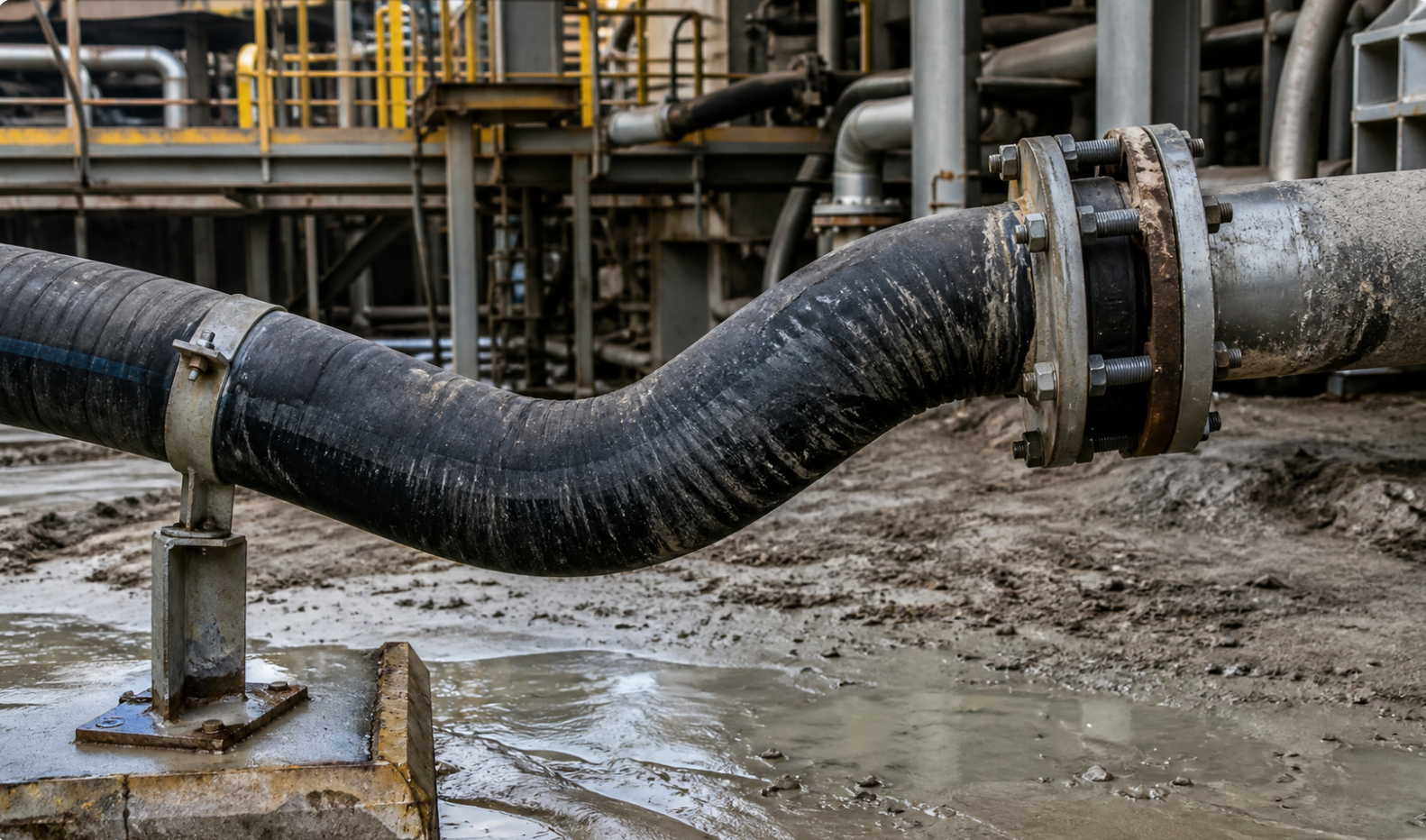
A mining hose is flexible, but flexibility does not mean it can operate at any bend radius.
When a hose is installed below its recommended minimum bend radius, the inner tube may fold or become compressed on the inside of the bend. At the same time, the reinforcement and outer cover are placed under additional stress.
Bends also change the slurry’s direction. Solid particles tend to strike the outer wall of the curve, creating a concentrated wear area. This is why a hose may fail at one particular bend while the rest of the hose remains in good condition.
Torsion, unsupported hose weight, vibration, and misaligned flanges can make the problem worse.
### 6. Incorrect Hose Selection
Not every rubber hose is designed for abrasive slurry service.
A hose may have the correct diameter and pressure rating but still be unsuitable because of its:
- Inner-tube compound
- Lining thickness
- Reinforcement construction
- Bend capability
- Electrical requirements
- Temperature resistance
- End-fitting design
A lightweight water hose, for example, should not be expected to deliver the same service life as a purpose-designed mining slurry hose.
## How to Choose the Right Mining Hose
Before requesting a quotation, provide the hose supplier with complete operating information.
At minimum, this should include:
- Material being transported
- Maximum and average particle size
- Particle shape and hardness
- Slurry concentration
- Required flow rate and velocity
- Normal operating pressure
- Maximum surge pressure
- Operating temperature
- Hose inside diameter and length
- Minimum installation bend radius
- Required flange or coupling type
- Whether the hose is fixed, vibrating, or frequently moved
Based on these conditions, the supplier can recommend an appropriate inner-lining material, wall thickness, reinforcement structure, pressure class, and connection system.
For severe abrasion areas, a heavier wear-resistant lining may provide longer service life. For installations exposed to movement or vibration, flexibility and reinforcement fatigue resistance may be equally important.
The best hose is not automatically the thickest or most expensive one. It is the hose whose complete construction matches the actual working conditions.
## Common Mistakes That Shorten Hose Life
### Selecting by Pressure and Diameter Only
Pressure and bore size are essential, but they do not describe the slurry’s abrasiveness. Particle information and flow conditions must also be evaluated.
### Ignoring Pressure Surges
Choosing a hose based only on normal gauge pressure can leave insufficient safety margin for blockages, pump pulsation, or valve events.
### Exceeding the Minimum Bend Radius
Forcing a hose into a tight layout creates mechanical stress and concentrates abrasive wear at the bend.
### Installing a Twisted Hose
A hose should not be twisted to align bolt holes or compensate for incorrect piping. Torsion can damage the reinforcement and reduce pressure performance.
### Using the Wrong Couplings
Poorly matched or incorrectly installed fittings can cause leakage, pull-off, local deformation, and premature failure near the hose ends.
### Waiting for Leakage Before Inspection
By the time slurry becomes visible outside the hose, the inner lining and reinforcement may already be seriously damaged. Regular external inspections and planned internal wear checks are safer than waiting for failure.
### Comparing Hoses Without Comparing Operating Conditions
Two hoses installed in different positions may have completely different service lives. A straight section and a discharge bend cannot be evaluated fairly without considering velocity, movement, pressure, and wear pattern.
## Practical Advice for Purchasing Teams
Purchasing decisions should be based on total operating cost rather than hose price alone.
A lower-priced hose may become expensive if it requires frequent replacement, causes production stoppages, or creates additional maintenance and safety risks. When comparing suppliers, procurement teams should evaluate:
- Expected performance under the stated application
- Inner-lining material and thickness
- Working-pressure rating
- Minimum bend radius
- Reinforcement and fitting construction
- Dimensional tolerances
- Quality-control procedures
- Traceability and test documentation
- Technical support before and after purchase
- Replacement frequency and downtime cost
It is also useful to keep service records for each installation point. Record the hose model, installation date, operating hours, failure location, and observed wear pattern. This information makes future selection more accurate and helps identify whether the root cause is abrasion, pressure, bending, installation, or system design.
## Choose a Mining Hose for the Application—not Just the Specification Sheet
A slurry hose wearing out faster than expected does not automatically mean the rubber quality is poor. Particle size, slurry concentration, flow velocity, working pressure, bending conditions, and hose selection can all have a major impact on service life.
Our mining slurry hoses are designed for abrasive material-handling applications and can be selected according to your operating pressure, slurry characteristics, installation layout, and connection requirements.
Send us your application details—including the transported material, particle size, slurry concentration, flow rate, pressure, hose dimensions, and bend conditions. Our team will help you identify a suitable hose construction and provide a solution tailored to your mining operation.
**Contact us today to discuss your slurry-handling application and request a hose recommendation or quotation.**